Recycling and Sustainability for Commercial Waste Yeading
 Commercial Waste Yeading is committed to turning the local eco-friendly waste disposal area into a high-performing model of urban sustainability. In this overview we outline how businesses and property managers in Yeading and surrounding boroughs can align with a sustainable rubbish area approach that reduces landfill, raises reuse rates and supports the circular economy. Our local programme balances operational efficiency with environmental ambition so that every tonne of commercial waste is managed responsibly.
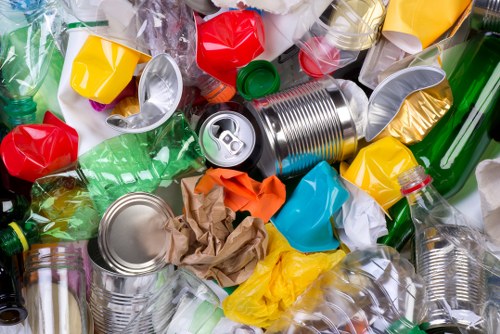
Every aspect of our Yeading commercial waste strategy references the boroughs' approach to waste separation: clear source segregation of paper and card, glass, metal and plastics, food waste and residual streams. We work closely with local authorities to reflect their sorting protocols, helping businesses comply with collection rules and maximise recycling capture. The scheme is designed for real-world workplaces — offices, retail units, light industrial units and hospitality — to make separation straightforward for staff and customers.
Recycling percentage target and performance tracking
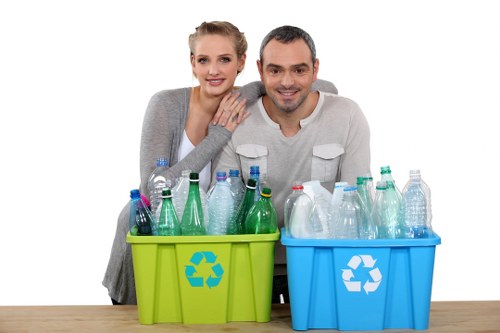
Our measurable ambition is a 65% recycling rate by 2030 for commercial waste in Yeading, with interim milestones of 50% by 2026 and 58% by 2028. To reach that recycling percentage target we use a mix of prevention, reuse, recycling and recovery actions. Key interventions include audits, targeted employee training, dedicated streams for high-value materials and monthly reporting so managers can see progress in real time. Practical steps to hit this target include:- Source separation stations for businesses with clear signage and colour-coded bins.
- Segregated collections for food waste to local AD facilities and paper/glass/plastic to licensed recycling centres.
- Regular waste composition checks to target improvements where contamination reduces recycling yields.
Local transfer stations and logistics
Commercial waste in Yeading benefits from proximate transfer stations and consolidation points that reduce vehicle miles and improve material routing. We coordinate with local transfer stations in Greenford, Southall and Park Royal to ensure sorted recyclate is loaded directly to specialist processors. These transfer hubs enable bulk movement and reduce handling that can compromise material quality. Working closely with transfer stations also supports rapid turnaround for segregated loads and minimises the time materials spend in temporary storage.
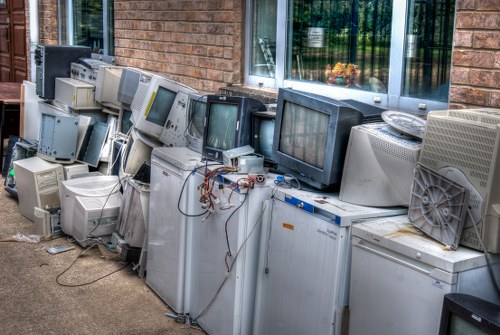 Partnerships with charities and reuse organisations are a cornerstone of our sustainable rubbish area model. Instead of consigning all non-hazardous items to waste, we run a commercial reuse pipeline for:
- Furniture and fixtures redirected to local furniture charities and community projects.
- Working electronics and appliances refurbished through social enterprises.
- Surplus packaging and boxed goods donated to food banks and redistribution groups where appropriate.
Strong relationships with local charities and accredited reuse organisations ensure that viable items get a second life, supporting the community while diverting bulky waste from disposal.
To make reuse practical, our teams maintain a scheduled collection service that separates charitable donations from recyclable streams at source and logs material flows. This reduces cross-contamination and ensures traceability for audit and environmental reporting.
 Low-carbon vans and fleet decarbonisation are central to reducing the carbon footprint of commercial waste services in Yeading. Our fleet strategy prioritises electric vehicles (EVs) and plug-in hybrids on urban rounds, supported by route optimisation software and telematics to cut unnecessary mileage. The low-carbon vans programme includes:
- Deployment of battery-electric vans for short, frequent stops in dense zones.
- Use of hybrid or Euro-6 standard vehicles where longer distances or heavier loads are unavoidable.
- Driver training for eco-driving techniques and automated reporting on fuel and energy use.
Combined with consolidation at transfer stations, these measures reduce emissions from collection activities and help Yeading businesses contribute to local air quality improvements. Our approach to the eco-friendly waste disposal area extends beyond vehicles to include low-energy lighting, solar-assisted operations at certain hubs, and a preference for electric handling equipment.
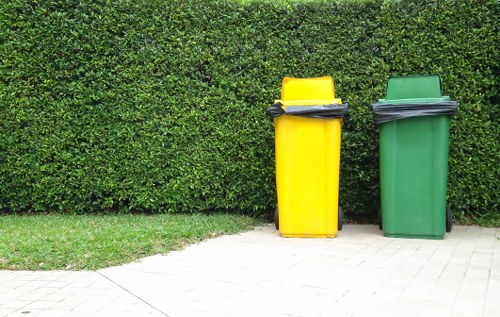 Implementing practical recycling activity in the area means offering dedicated streams for key material types: glass, cardboard, mixed recycling, organics (food waste), bulky items and e-waste. For example, hospitality and food-service venues in Yeading are supported to move food waste to anaerobic digestion facilities, producing biogas and nutrient-rich biofertiliser. Retail and office sectors are encouraged to maximise cardboard and paper separation and to participate in mattress and furniture take-back schemes for bulky recovery.
Across the programme we embed continuous improvement: regular audits, contamination reduction campaigns, and business-level performance reviews aligned to the boroughs' waste separation guidance. Reporting frameworks track progress toward the recycling percentage target, show the carbon savings from low-carbon vans, and quantify the contribution of charity partnerships to reuse rates. The result is a resilient, verifiable pathway to a more sustainable commercial waste system in Yeading.
In closing, our strategy for Commercial Waste Yeading brings together practical logistics, community partnerships and measurable sustainability goals to create an effective, eco-friendly waste disposal area and a model sustainable rubbish area for other districts to emulate. With clear targets, local transfer infrastructure, charity reuse networks and a low-carbon fleet, Yeading businesses can reduce waste, cut emissions and support circular economy outcomes.
